News
General
3 views
Are we watching the same game? Same news? Same debate?
Sep 28, 2026
📍 Phliadelphia,PA, USA
### Reading 2026’s Geopolitical Conflicts as More Than a Series of Separate Crises
My mother watches football the way many people watch the news: as a succession of impacts. Large men collide, someone falls, a whistle blows, and then the sequence begins again. She asks why the players keep doing it, and I rarely have a satisfying answer. From where she is sitting, there is no larger logic. It looks like organized chaos because, without knowing the language of football, that is exactly what it is.
I watch the game one level above her. I understand the basic language, can recognize a blitz and usually understand why a team chooses to punt on fourth down. Having played high school football helps, but I still rely on commentators to explain what I am seeing. I can follow the story without necessarily seeing the entire strategy.
Then there is the Tom Brady level of understanding: the ability to see a formation not simply as a play, but as part of a sequence. A defensive tendency shown earlier may be exploited much later. A formation can be designed to create an opportunity several plays down the field.
Geopolitical events can work in much the same way. Depending on how closely we follow them, we can see isolated events, recognize recurring patterns or attempt to understand how several developments might fit into a broader strategic competition.
### The View From the Couch
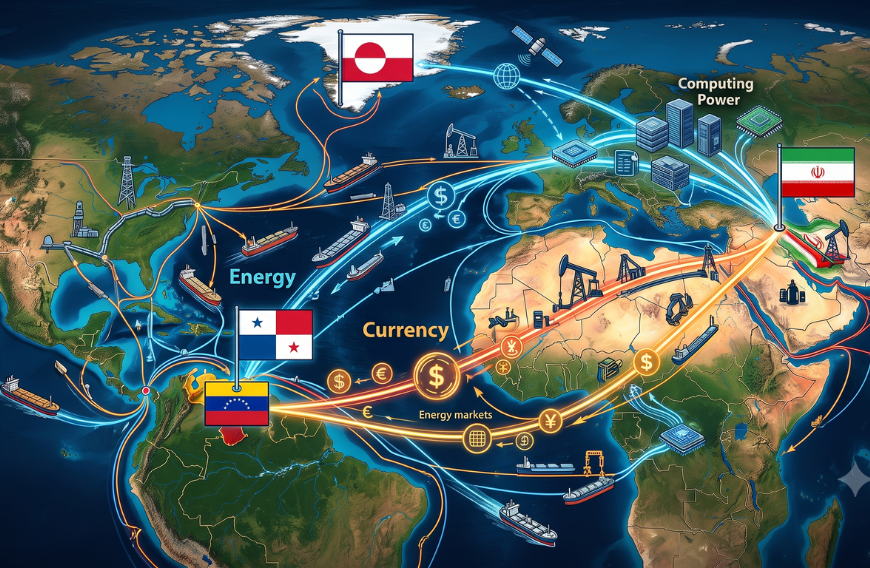
Viewed individually, many of the major geopolitical developments of 2026 can appear disconnected. The conflict involving Iran, tensions surrounding Venezuela, renewed attention to the Panama Canal, the dispute involving Greenland and Denmark, and the growing competition over semiconductors, rare earth minerals and energy infrastructure each have their own immediate explanations.
But there are also common themes running through them: energy security, access to strategic resources, financial systems, transportation routes, technology and national security.
That does not mean every event has a single cause or that all of the countries involved are following one master plan. It does mean that the same underlying strategic resources increasingly appear across seemingly separate disputes.
### The Subtitled Version
The relationship between China and Iran illustrates why a longer view can change the way individual events are understood.
China and Iran signed a 25-year cooperation agreement in March 2021, describing their relationship as a strategic partnership and outlining broader cooperation in areas including energy and infrastructure. Reports at the time also associated the agreement with a proposed $400 billion Chinese investment framework, although the headline figure represented an ambitious long-term framework rather than a single immediate investment.
China has subsequently remained a major buyer of Iranian oil. Recent analysis has estimated that China accounted for roughly 90% of Iran's sanctioned oil exports before the war disrupted shipping, while Chinese imports of Iranian crude have since fallen sharply because of disruptions around the Strait of Hormuz.
The significance is not simply the volume of oil. Energy transactions also intersect with sanctions, shipping networks, currencies and financial infrastructure. Those connections make energy security part of a much larger strategic conversation.
The conflict around Iran therefore cannot be understood solely through the question of nuclear facilities or military operations. It also has consequences for energy markets, China's supply security, Russia's relationship with Tehran and the wider system of international sanctions.
China's own response to the Hormuz disruption illustrates that complexity. Brookings reported that Chinese oil imports had risen 16% year over year during January and February 2026, before the conflict began, as Beijing increased purchases amid growing concerns about energy security. After the conflict started, however, China sharply reduced some oil imports and moved to protect domestic fuel supplies.
The numbers do not prove that the conflict was fundamentally about China. They demonstrate something more straightforward: a regional military crisis can quickly become an economic and strategic problem for countries far beyond the immediate battlefield.
### Russia, Iran and Alternative Networks
Russia's relationship with Iran provides another example of how economic and security issues overlap.
In 2024, Moscow and Tehran were already moving toward deeper strategic cooperation. Russia's foreign minister said that a planned comprehensive partnership treaty would include defense cooperation, while Reuters reported that both governments were seeking closer economic and strategic ties amid Western sanctions.
A Russian government roadmap approved in September 2024, later reported from a document obtained and reviewed by Fox News, outlined cooperation involving financial channels, national-currency transactions, energy, nuclear projects, transportation and aviation. The document itself does not establish which projects remained active or how they were affected by subsequent events.
These developments matter because sanctions are increasingly being treated not simply as restrictions on individual countries, but as a contest over the infrastructure through which international commerce takes place.
Alternative payment systems, national currencies, shipping arrangements and non-Western trade networks can reduce exposure to Western financial pressure. That does not make them automatically successful or permanent, but their development is an important part of the broader geopolitical competition.
### Reading the Whole Field
The same broader perspective can be applied to other developments.
Venezuela remains central to the global energy picture because of its enormous oil reserves, while the country's relationship with China has historically included significant oil trade. In 2026, U.S. policy toward Venezuela has also involved oil, sanctions, security and control over sanctioned shipments. The political situation has changed rapidly, making individual events difficult to interpret without considering the larger energy and regional context.
Greenland presents a different combination of issues. The territory is strategically important because of its location in the Arctic and its mineral resources, while the United States, Denmark and Greenland have been negotiating questions involving defense and security. In September 2026, the three sides reached an agreement allowing an expanded U.S. military presence, including plans involving missile defense and additional facilities.
Rare earth minerals provide another connection between economics and national security. China continues to dominate much of the world's rare-earth mining and processing capacity, giving Beijing significant leverage over industries ranging from electronics to defense. Reuters reported in September that this dependence was influencing the tone of U.S.-China negotiations.
And then there is computing power.
The competition over semiconductors, advanced manufacturing, electricity and data centers reflects the growing recognition that artificial intelligence depends on physical infrastructure. Chips require specialized manufacturing. Data centers require enormous amounts of electricity. AI systems require increasingly sophisticated computing hardware.
That means technology competition is no longer confined to laboratories or software companies. It increasingly involves energy policy, industrial policy, mineral supplies, manufacturing capacity and national security.
### One Season, Several Games
The football analogy is useful here, but only up to a point.
Iran, Russia, China, Venezuela, the United States and other countries are not players controlled by a single coach. Each has its own interests, domestic pressures and strategic objectives.
Iran's relationship with China predates the current conflict. Russia has its own reasons for seeking sanctions-resistant financial and economic relationships. Venezuela's government has its own political and economic priorities. China has its own energy and security calculations.
Treating every event as part of one centrally coordinated strategy would therefore risk oversimplifying the situation.
But the opposite mistake is to treat every event as completely independent.
Energy, finance, minerals, shipping routes, technology and military power increasingly overlap. A decision made in one area can alter the calculations in another. Disruptions to oil shipments can affect China. Restrictions on rare earths can affect technology companies. Semiconductor policy can influence national security. Data-center expansion can become an electricity and infrastructure issue.
The connections are real even when the actors' intentions are different.
### A Longer Game
This may be the most important change in how geopolitical competition should be viewed.
Governments frequently operate on different time horizons. Elections and political administrations work in years, while infrastructure projects, supply chains, energy investments and strategic partnerships can take decades to develop.
China's 2021 agreement with Iran was explicitly structured around a 25-year relationship. Russia's 2024 roadmap with Iran covered multiple years of cooperation. Meanwhile, the United States and China continue to compete over technology, trade, AI, minerals and energy security.
None of this establishes that every geopolitical confrontation in 2026 was deliberately designed as part of one unified strategy. It does show why individual headlines can be misleading when viewed in isolation.
My mother will probably continue watching football as a series of collisions. I will keep watching from one level higher, recognizing formations and trying to understand why a team repeats a particular play.
And perhaps the real lesson is that geopolitics requires an even higher vantage point.
The objective is not necessarily to discover a single hidden playbook. It is to recognize the relationships among energy, money, resources, technology and security without assuming that every move comes from the same play caller.
In a year filled with seemingly separate crises, that distinction may be the difference between simply watching the collisions and beginning to understand the game.
My mother watches football the way many people watch the news: as a succession of impacts. Large men collide, someone falls, a whistle blows, and then the sequence begins again. She asks why the players keep doing it, and I rarely have a satisfying answer. From where she is sitting, there is no larger logic. It looks like organized chaos because, without knowing the language of football, that is exactly what it is.
I watch the game one level above her. I understand the basic language, can recognize a blitz and usually understand why a team chooses to punt on fourth down. Having played high school football helps, but I still rely on commentators to explain what I am seeing. I can follow the story without necessarily seeing the entire strategy.
Then there is the Tom Brady level of understanding: the ability to see a formation not simply as a play, but as part of a sequence. A defensive tendency shown earlier may be exploited much later. A formation can be designed to create an opportunity several plays down the field.
Geopolitical events can work in much the same way. Depending on how closely we follow them, we can see isolated events, recognize recurring patterns or attempt to understand how several developments might fit into a broader strategic competition.
### The View From the Couch
Viewed individually, many of the major geopolitical developments of 2026 can appear disconnected. The conflict involving Iran, tensions surrounding Venezuela, renewed attention to the Panama Canal, the dispute involving Greenland and Denmark, and the growing competition over semiconductors, rare earth minerals and energy infrastructure each have their own immediate explanations.
But there are also common themes running through them: energy security, access to strategic resources, financial systems, transportation routes, technology and national security.
That does not mean every event has a single cause or that all of the countries involved are following one master plan. It does mean that the same underlying strategic resources increasingly appear across seemingly separate disputes.
### The Subtitled Version
The relationship between China and Iran illustrates why a longer view can change the way individual events are understood.
China and Iran signed a 25-year cooperation agreement in March 2021, describing their relationship as a strategic partnership and outlining broader cooperation in areas including energy and infrastructure. Reports at the time also associated the agreement with a proposed $400 billion Chinese investment framework, although the headline figure represented an ambitious long-term framework rather than a single immediate investment.
China has subsequently remained a major buyer of Iranian oil. Recent analysis has estimated that China accounted for roughly 90% of Iran's sanctioned oil exports before the war disrupted shipping, while Chinese imports of Iranian crude have since fallen sharply because of disruptions around the Strait of Hormuz.
The significance is not simply the volume of oil. Energy transactions also intersect with sanctions, shipping networks, currencies and financial infrastructure. Those connections make energy security part of a much larger strategic conversation.
The conflict around Iran therefore cannot be understood solely through the question of nuclear facilities or military operations. It also has consequences for energy markets, China's supply security, Russia's relationship with Tehran and the wider system of international sanctions.
China's own response to the Hormuz disruption illustrates that complexity. Brookings reported that Chinese oil imports had risen 16% year over year during January and February 2026, before the conflict began, as Beijing increased purchases amid growing concerns about energy security. After the conflict started, however, China sharply reduced some oil imports and moved to protect domestic fuel supplies.
The numbers do not prove that the conflict was fundamentally about China. They demonstrate something more straightforward: a regional military crisis can quickly become an economic and strategic problem for countries far beyond the immediate battlefield.
### Russia, Iran and Alternative Networks
Russia's relationship with Iran provides another example of how economic and security issues overlap.
In 2024, Moscow and Tehran were already moving toward deeper strategic cooperation. Russia's foreign minister said that a planned comprehensive partnership treaty would include defense cooperation, while Reuters reported that both governments were seeking closer economic and strategic ties amid Western sanctions.
A Russian government roadmap approved in September 2024, later reported from a document obtained and reviewed by Fox News, outlined cooperation involving financial channels, national-currency transactions, energy, nuclear projects, transportation and aviation. The document itself does not establish which projects remained active or how they were affected by subsequent events.
These developments matter because sanctions are increasingly being treated not simply as restrictions on individual countries, but as a contest over the infrastructure through which international commerce takes place.
Alternative payment systems, national currencies, shipping arrangements and non-Western trade networks can reduce exposure to Western financial pressure. That does not make them automatically successful or permanent, but their development is an important part of the broader geopolitical competition.
### Reading the Whole Field
The same broader perspective can be applied to other developments.
Venezuela remains central to the global energy picture because of its enormous oil reserves, while the country's relationship with China has historically included significant oil trade. In 2026, U.S. policy toward Venezuela has also involved oil, sanctions, security and control over sanctioned shipments. The political situation has changed rapidly, making individual events difficult to interpret without considering the larger energy and regional context.
Greenland presents a different combination of issues. The territory is strategically important because of its location in the Arctic and its mineral resources, while the United States, Denmark and Greenland have been negotiating questions involving defense and security. In September 2026, the three sides reached an agreement allowing an expanded U.S. military presence, including plans involving missile defense and additional facilities.
Rare earth minerals provide another connection between economics and national security. China continues to dominate much of the world's rare-earth mining and processing capacity, giving Beijing significant leverage over industries ranging from electronics to defense. Reuters reported in September that this dependence was influencing the tone of U.S.-China negotiations.
And then there is computing power.
The competition over semiconductors, advanced manufacturing, electricity and data centers reflects the growing recognition that artificial intelligence depends on physical infrastructure. Chips require specialized manufacturing. Data centers require enormous amounts of electricity. AI systems require increasingly sophisticated computing hardware.
That means technology competition is no longer confined to laboratories or software companies. It increasingly involves energy policy, industrial policy, mineral supplies, manufacturing capacity and national security.
### One Season, Several Games
The football analogy is useful here, but only up to a point.
Iran, Russia, China, Venezuela, the United States and other countries are not players controlled by a single coach. Each has its own interests, domestic pressures and strategic objectives.
Iran's relationship with China predates the current conflict. Russia has its own reasons for seeking sanctions-resistant financial and economic relationships. Venezuela's government has its own political and economic priorities. China has its own energy and security calculations.
Treating every event as part of one centrally coordinated strategy would therefore risk oversimplifying the situation.
But the opposite mistake is to treat every event as completely independent.
Energy, finance, minerals, shipping routes, technology and military power increasingly overlap. A decision made in one area can alter the calculations in another. Disruptions to oil shipments can affect China. Restrictions on rare earths can affect technology companies. Semiconductor policy can influence national security. Data-center expansion can become an electricity and infrastructure issue.
The connections are real even when the actors' intentions are different.
### A Longer Game
This may be the most important change in how geopolitical competition should be viewed.
Governments frequently operate on different time horizons. Elections and political administrations work in years, while infrastructure projects, supply chains, energy investments and strategic partnerships can take decades to develop.
China's 2021 agreement with Iran was explicitly structured around a 25-year relationship. Russia's 2024 roadmap with Iran covered multiple years of cooperation. Meanwhile, the United States and China continue to compete over technology, trade, AI, minerals and energy security.
None of this establishes that every geopolitical confrontation in 2026 was deliberately designed as part of one unified strategy. It does show why individual headlines can be misleading when viewed in isolation.
My mother will probably continue watching football as a series of collisions. I will keep watching from one level higher, recognizing formations and trying to understand why a team repeats a particular play.
And perhaps the real lesson is that geopolitics requires an even higher vantage point.
The objective is not necessarily to discover a single hidden playbook. It is to recognize the relationships among energy, money, resources, technology and security without assuming that every move comes from the same play caller.
In a year filled with seemingly separate crises, that distinction may be the difference between simply watching the collisions and beginning to understand the game.
Tags
news
Comments (0)
Login to post comments
No comments yet
Be the first to share your thoughts about this post.