News
General
50 views
‘South Asian culture is not just Indian’: Influencer takes aim at ‘Best of the Best’ critics
Oct 01, 2026
📍 Phliadelphia,PA, USA
### UK Influencer Says ‘Best of the Best’ Highlights the Diversity of South Asian Representation
A UK-based Malayali influencer has sparked a broader discussion about South Asian representation and diaspora identity following the release of Netflix’s *Best of the Best*, arguing that no single film can capture the experiences of an entire region.
Shilpa, who shares her views on Instagram under the handle @lateafternoonthoughts, addressed criticism surrounding the film while discussing the complexities of defining authentic South Asian representation in Western media.
Shilpa acknowledged that she understands some of the concerns raised about the way South Asian culture is presented in Western spaces. Referring to discussions about South Asian fashion and cultural imagery at Coachella, she said she also recognizes how certain elements of the culture can sometimes be selected because they are visually appealing or popular online.
“I do think that Western deity influencers sometimes handpick the most aesthetic and appealing parts of our culture and use it for their own virality,” she said.
At the same time, she argued that a cultural portrayal does not necessarily have to resonate with every member of the South Asian community to be considered meaningful representation.
“I don’t have to like it for it to be a valid representation of millions of people,” Shilpa said.
A central part of her argument was that South Asian identity should not automatically be equated with Indian identity. She emphasized that the region encompasses numerous countries, communities, languages, religions and cultural traditions.
“South Asian culture is not monopolized by Indians,” she said, adding that it is overly narrow to assume that discussions about South Asian culture are always discussions about Indian culture.
Shilpa pointed to the diversity of the South Asian region, noting that it includes nine countries with distinct identities and subcultures, even though they may share certain cultural similarities.
She also emphasized that India itself contains enormous regional and linguistic diversity, making it difficult to define a single Indian or South Indian experience.
The influencer further addressed criticism directed at diaspora communities for allegedly being disconnected from their cultural roots. She argued that migration inevitably creates new generations who may develop different ways of understanding and reconnecting with their heritage.
“You do realize that your migration will also result in a diaspora population who will then be a generation of kids trying to connect to a culture that you’ve actively moved away from,” she said.
As an example, Shilpa referred to the Bollywood-fusion dance culture that has become popular on American college campuses. Although some critics may view intercollegiate Bollywood dance as an imperfect or commercialized connection to South Asian culture, she said the effort still represents an attempt by diaspora students to engage with their heritage.
She was also clear that she does not consider *Best of the Best* a comprehensive portrayal of South Indian life.
“No, ‘Best of the Best’ is not a good representation of all South Indians,” she said.
However, she questioned whether any individual movie should be expected to accurately represent billions of people with different cultural backgrounds, religions, interests and community identities.
“I think it’s quite obtuse to think that any single piece of media can accurately represent two billion different people across religions, communities, interests,” Shilpa said.
Instead, she views the film as one contribution to a much larger process of diaspora representation. According to Shilpa, seeing one particular South Asian experience reach a mainstream audience can create opportunities for other communities and stories to receive attention.
“The fact is, it did represent thousands of South Asian diaspora kids across the world,” she said. “Representation happens step by step.”
She suggested that the success and visibility of one type of story could eventually make room for films centered on other parts of the diaspora, including immigrant students and queer South Asian communities.
Her broader argument is that representation does not have to be treated as an all-or-nothing issue. A film can authentically connect with one section of the diaspora without claiming to speak for everyone.
“We should want it all,” Shilpa said, urging members of different South Asian communities to support representation of communities beyond their own.
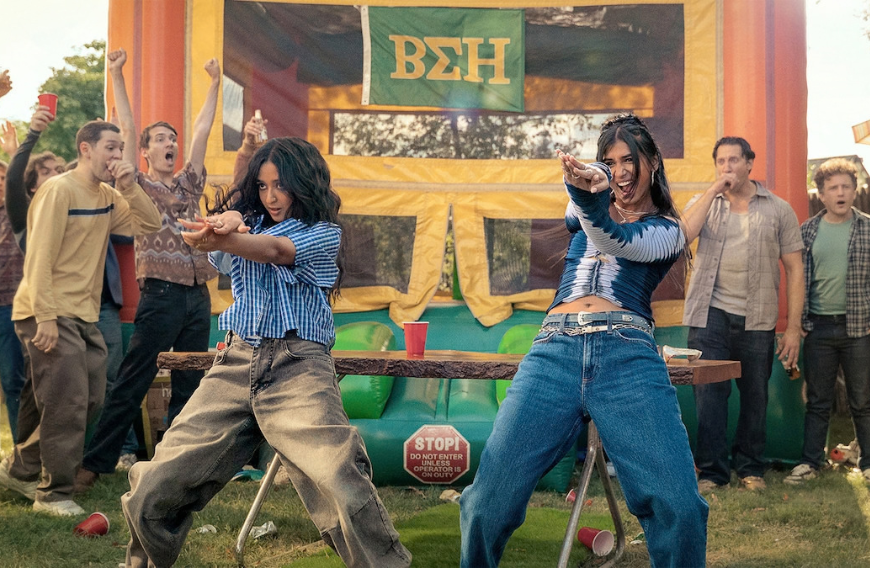
The discussion comes as *Best of the Best* brings a South Asian American coming-of-age story to a mainstream Netflix audience. Directed by Lena Khan, the 2026 comedy follows childhood friends Maya, played by Maitreyi Ramakrishnan, and Anjali, played by Kedia, as they join UCLA’s competitive Bollywood-fusion dance team while pursuing a U.S. championship.
The dance competition serves as the backdrop for a broader story about growing up between cultures. Bollywood music, wedding choreography, the South Asian Students Association, Indian American names and references to the Kohinoor are woven into the characters’ everyday experiences.
For many South Asian immigrants and children of immigrants, that familiarity is an important part of the film’s appeal. Rather than constantly explaining South Asian culture to a mainstream audience, the movie presents cultural references as an ordinary part of diaspora life.
The debate surrounding *Best of the Best* ultimately reflects the diversity of the South Asian diaspora itself. Different communities bring different histories, cultural experiences and expectations to conversations about what representation should look like on screen.
Rather than viewing one film as a definitive portrayal of South Asian identity, Shilpa’s argument frames it as one contribution to a much larger and continuing conversation about whose stories are being seen and who gets to recognize themselves in mainstream media.
Tags
news
Comments (0)
Login to post comments
No comments yet
Be the first to share your thoughts about this post.