News
General
203 views
3 Reasons why AI solved a math problem humans could not for 80 years
Jun 01, 2026
📍 Philadelphia, PA, USA
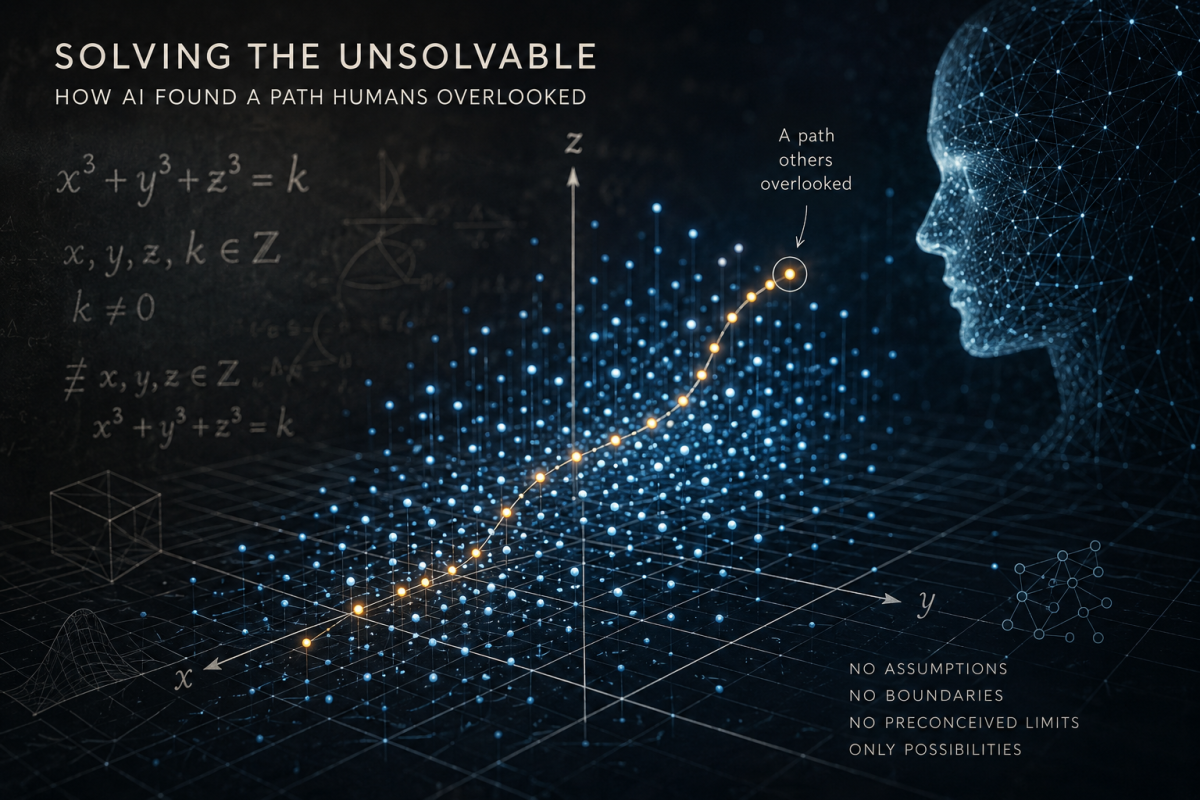
🤖🧠 A groundbreaking artificial intelligence breakthrough is sparking global debate after an AI system reportedly solved a decades-old mathematical problem that had challenged some of the world’s brightest mathematicians for nearly 80 years. While the achievement itself is remarkable, experts say the bigger story may not be about mathematics at all — it may be about how humans think, learn, and solve problems in the modern age.
The AI succeeded by discovering a completely different solution path that generations of researchers had largely overlooked. Instead of following long-standing assumptions accepted by experts, the system explored possibilities without bias, eventually finding an arrangement that disproved a famous mathematical conjecture proposed by legendary mathematician Paul Erdős. The discovery demonstrated that sometimes breakthroughs emerge not from proving accepted ideas, but from questioning them.
Researchers say the result highlights a growing challenge within human knowledge systems. As education and careers become increasingly specialized, experts often focus deeply on narrow fields, making it harder to connect ideas across disciplines. Artificial intelligence, however, can draw from multiple areas of knowledge simultaneously, combining concepts from different branches of mathematics and science in ways that humans rarely attempt.
The achievement has also renewed conversations about attention, focus, and creativity. Unlike humans, AI does not become distracted, frustrated, or constrained by limited time. It can continuously test possibilities, revisit failed approaches, and explore unlikely paths without losing momentum. Many observers argue that the breakthrough serves as a reminder that some of humanity’s greatest strengths — curiosity, independent thinking, interdisciplinary learning, and deep concentration — may be becoming harder to maintain in an increasingly distracted world.
Rather than proving that machines are smarter than humans, the discovery may reveal something even more important: the need for people to reclaim the habits of thinking that have historically driven innovation and progress. As AI continues advancing, the future may belong not to those who compete with machines, but to those who learn how to think more creatively, question assumptions more boldly, and connect ideas across boundaries more effectively than ever before. 🌍🚀
The AI succeeded by discovering a completely different solution path that generations of researchers had largely overlooked. Instead of following long-standing assumptions accepted by experts, the system explored possibilities without bias, eventually finding an arrangement that disproved a famous mathematical conjecture proposed by legendary mathematician Paul Erdős. The discovery demonstrated that sometimes breakthroughs emerge not from proving accepted ideas, but from questioning them.
Researchers say the result highlights a growing challenge within human knowledge systems. As education and careers become increasingly specialized, experts often focus deeply on narrow fields, making it harder to connect ideas across disciplines. Artificial intelligence, however, can draw from multiple areas of knowledge simultaneously, combining concepts from different branches of mathematics and science in ways that humans rarely attempt.
The achievement has also renewed conversations about attention, focus, and creativity. Unlike humans, AI does not become distracted, frustrated, or constrained by limited time. It can continuously test possibilities, revisit failed approaches, and explore unlikely paths without losing momentum. Many observers argue that the breakthrough serves as a reminder that some of humanity’s greatest strengths — curiosity, independent thinking, interdisciplinary learning, and deep concentration — may be becoming harder to maintain in an increasingly distracted world.
Rather than proving that machines are smarter than humans, the discovery may reveal something even more important: the need for people to reclaim the habits of thinking that have historically driven innovation and progress. As AI continues advancing, the future may belong not to those who compete with machines, but to those who learn how to think more creatively, question assumptions more boldly, and connect ideas across boundaries more effectively than ever before. 🌍🚀
Tags
news
Comments (0)
Login to post comments
No comments yet
Be the first to share your thoughts about this post.